GEPA in the Loop
• 1 min read 1 min
What I worked on
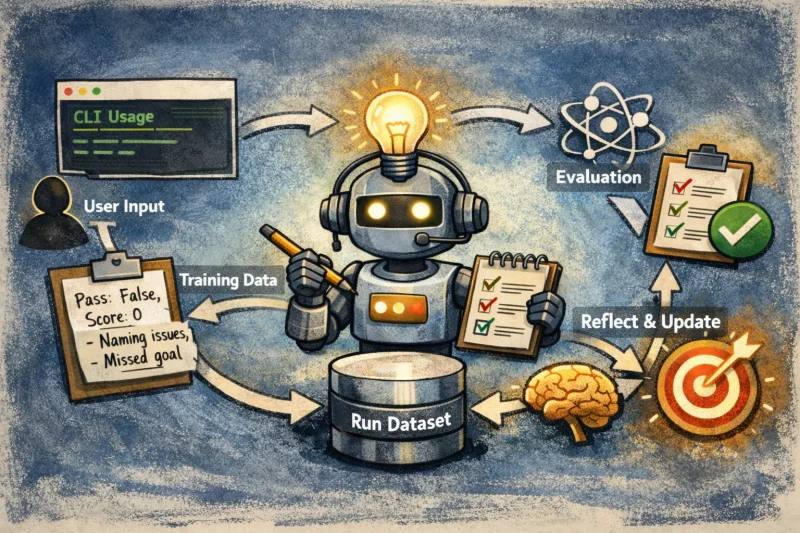
Designed and agentically implemented the full GEPA training loop rather than treating prompt optimization as an offline or synthetic task. It looks like this:
flowchart TD
  U[User] -->|types request| CLI[CLI]
  CLI -->|goal + context| S[Server]
  S --> AO[AgentOrchestrator]
  AO --> BR[BundleResolver]
  BR --> B[(Active Prompt Bundle)]
  B --> LOOP[Agentic Loop Execution]

  LOOP -->|artifacts| RUNS[(Run Store)]
  LOOP -->|repeat across steps| LOOP
  CLI -->|many requests over time| AO

  RUNS --> DS[(Training Dataset)]
  DS --> GEPA[GEPA Prompt Optimizer]

  GEPA -->|spawn candidate bundle| CAND[Candidate Bundle]
  CAND --> LOOP

  LOOP --> EVAL[Evaluation Framework]
  EVAL -->|score + flags| SCORES[(Scores Store)]
  SCORES --> GEPA

  GEPA -->|update active bundle| B

  subgraph Eval Maturity
    M1[Now: Manual validation]
    M2[Next: Deterministic tests]
    M3[Later: LLM judge]
    M1 --> M2 --> M3
  end

  EVAL -. uses .-> M1
  EVAL -. evolves to .-> M2
  EVAL -. evolves to .-> M3

  B -->|better prompts next time| AO
What I noticed
- Strong law of small numbers but still increasing confidence that judgment is a friction point
- Despite having tests, the only way to verify the system worked was to manually run the CLI and inspect artifacts
- When I ask it to do something I’m unsure about myself (e.g. GEPA integration) the feedback I provide becomes much larger
”Aha” Moment
N/A
What still feels messy
- GEPA technically runs but doesn’t make useful predictions yet
- Current implementation isn’t doing reflective mutation via an LLM
- I’m passing one practice/policy but real behavior comes from multiple practices/policies acting together
Next step
- Revisit GEPA setup to support reflective mutation & validate full run